By Sarina Gomez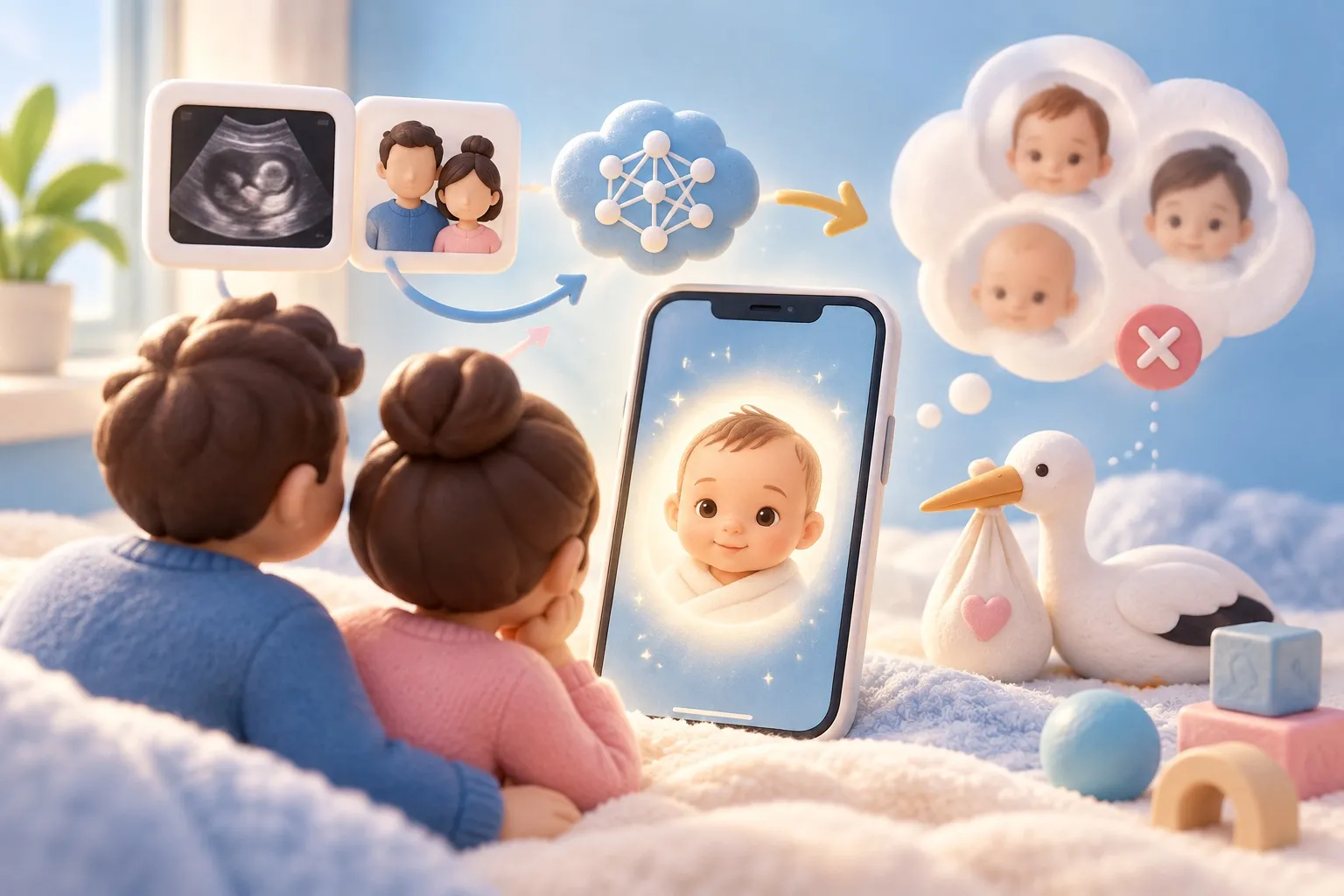
AI baby generators are not accurate in the sense most people mean: none of them can show the face your baby will actually have. What they do is imagine a plausible baby face from what’s in your photos, using patterns learned from huge numbers of images. From a clear 3D scan they can stay close to the shape the scan shows. From parents’ photos they make one believable blend out of countless possible children. Either way, the result is a guess.
How an AI baby generator works
An AI baby generator is an image model that has learned what faces, and baby faces in particular, tend to look like. You give it an input, and it produces a new picture that fits both the input and everything it learned.
The process, simplified:
- You upload a photo: an ultrasound, or one photo of each parent.
- The model reads what’s visible: the shape of the head and profile on a scan, or skin tone, hair, eye color and face shape in parents’ photos.
- It fills in everything else: skin texture, eyelashes, the exact curve of the lips, lighting, the blanket. None of that comes from your photo.
- You get one finished portrait.
Step 3 is where accuracy ends. The model has no access to your baby’s DNA, and it can’t see through the parts of a scan that are blurred, shadowed or hidden behind a hand. It draws the most plausible answer, not the true one.
From an ultrasound: what’s real and what’s imagined
When the input is a scan, the generator is closest to “accurate” in the outline and furthest in the details. A 3D scan carries real information about the shape of the forehead, nose and chin, the fullness of the cheeks and the pose. The generator can keep that and add a newborn’s skin and color around it.
But a scan is made of echoes, not light, and it has limits:
- Babies gain fat in the final weeks. ACOG notes fat starts forming under the skin at 21 to 24 weeks and the skin smooths as more fat is added at 25 to 28 weeks, so a scan at 24 weeks shows a thinner face than the newborn will have.
- Fluid, hands and the cord can smudge or hide parts of the face.
- A scan shows no color at all, so skin tone, eye color and hair are invented.
The same is true of “8K ultrasound” images. A 2025 review of AI-enhanced fetal images found they look clearer to parents but add “algorithmically inferred features” with no assurance they match the real anatomy, and showed no diagnostic value. Our 8K ultrasound explainer covers this in detail.
From parents’ photos: why it can only be one of many babies
From parents’ photos, the generator can only show one possible child, because genetics doesn’t produce one fixed answer. Each child gets a different mix of each parent’s genes, which is why siblings can look so different.
Many visible traits are shaped by several genes at once. MedlinePlus Genetics explains that eye color depends mainly on two genes on chromosome 15, OCA2 and HERC2, plus several others with smaller roles, which “combine … to produce a continuum of eye colors.” A generator looking at two parents’ photos can’t know which variants either parent carries, let alone which ones the baby inherits.
So the honest way to read a parents’ photo portrait is: “a believable child of these two people”, not “our child”. For the genetics behind each trait, read what will my baby look like.
What AI baby generators can and can’t do
| Can | Can’t |
|---|---|
| Make a believable newborn face from a scan or parents’ photos | Show your baby’s real face |
| Keep the head shape and pose of a clear 3D scan | Recover detail the scan didn’t capture |
| Reflect information you give it (heritage, a known sex) | Know your baby’s eye or hair color |
| Blend visible features from both parents | Know which genes your baby inherited |
| Give you a fun picture to share | Tell you anything medical about the pregnancy |
| Make a playful guess about the sex, if designed to | Tell you the sex reliably |
How SeeMyBaby imagines a portrait
SeeMyBaby is built around these limits rather than hiding them. It turns one photo of your 2D, 3D or 4D scan into an imagined newborn portrait in about a minute, or one photo of each parent into a newborn who blends both. A few things steer the result:
- The scan itself. Clearer 3D or 4D scans with a visible profile give the closest result. A 2D scan still works, but more of the face is imagined.
- Your answers. The app asks about trimester, the sex if you know it, and heritage (White, Black/African American, Hispanic/Latino, Asian, or “rather not say”) to steer skin tone and features.
- What you’re curious about, such as eyes, nose and smile, or family resemblance.
It’s entertainment: an imagined portrait, not a prediction and not a medical tool.
How to get a closer imagined result
You can’t make any generator accurate, but you can give it better material.
- Use your clearest scan. A 3D still with the face in profile and nothing blocking it is best. Our guide to getting clear 3D ultrasound pictures has tips.
- Photograph the printout well: flat, in daylight, no flash, phone held parallel to the paper.
- For parents’ photos, use front-facing, evenly lit photos without sunglasses, heavy filters or hats.
- Answer the questions honestly, especially heritage and the known sex.
- Read the result as a picture, not a promise.
Before uploading anything, check how the app handles your photos with our AI baby generator privacy checklist. More guides are on the blog.
Questions parents ask
Are AI baby generators accurate?
No. They make a plausible, imagined face from your photos, not your baby’s real face. A clear 3D scan gives the closest outline, but skin, eyes and hair are always invented.
Do AI baby generators work?
They work as fun image tools: they reliably make a believable baby picture. They don’t work as predictions, because they can’t see your baby’s genes or anything the scan didn’t capture.
How does an AI baby generator work?
An image model trained on many faces reads what’s visible in your scan or parents’ photos, then fills in the rest with what baby faces typically look like.
Can an AI tell the baby’s sex from an ultrasound?
Not reliably. Any app guess about the sex should be treated as a playful guess, not a result. Your provider’s scan or blood test is how the sex is actually found out.

Also available in: العربية · Deutsch · Español · Français · 日本語 · 한국어 · Português (Brasil)