By Sarina Gomez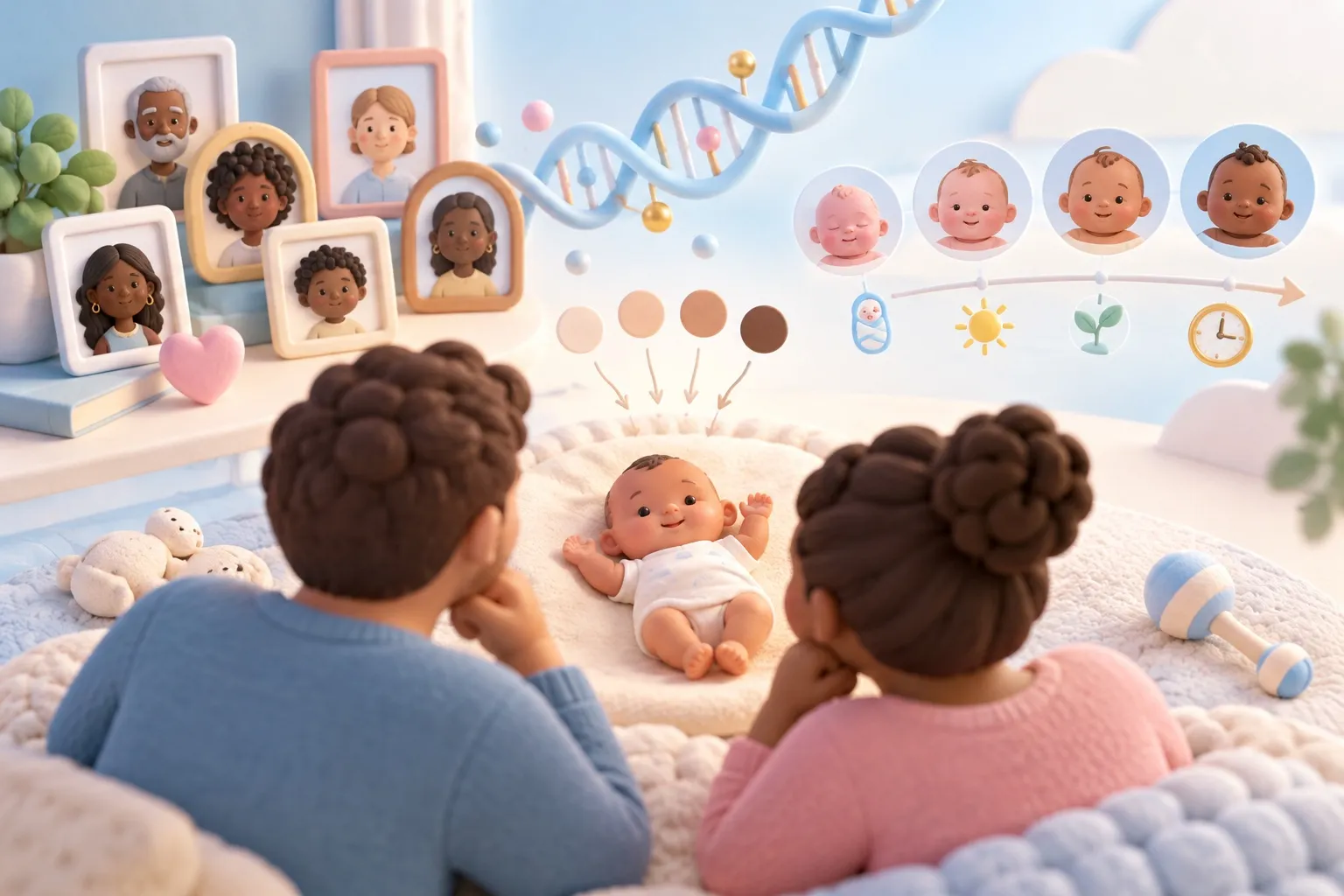
Your baby’s skin color will be shaped by many genes from both of you, so it usually lands somewhere within the range of shades in your two families, and siblings can land in different places. Don’t judge it in the first days, either: newborns look redder or purplish at birth, and babies of every heritage start out lighter than the shade they grow into.
Here’s how the genetics works, why it rarely follows a simple rule, and what to expect from your newborn’s skin in the first weeks.
Skin color is decided by many genes, not one
Skin color is a polygenic trait: lots of gene variants each nudge it a little lighter or darker. The color itself comes from melanin, a pigment made by cells called melanocytes. According to MedlinePlus Genetics, those cells make two forms of melanin. Eumelanin is brown-black; pheomelanin is red-yellow. The balance between them, and how much is made, helps set the color of a person’s skin and hair.
Several genes steer that process. MC1R controls which form of melanin is made, and common variations in it are linked to normal differences in skin and hair color, including the fair, freckled skin that often comes with red hair. The OCA2 gene makes a protein that’s essential for normal pigmentation.
The list keeps growing. A 2017 study in Science of ethnically diverse African populations found variants in or near six genes (SLC24A5, MFSD12, DDB1, TMEM138, OCA2 and HERC2) significantly tied to skin pigmentation. The authors opened by noting that, despite the wide range of human skin color, little is known about its genetic basis across global populations. That’s the honest state of the science: there are many genes involved, and not all of them have been found.
Why a baby can be lighter or darker than both parents
Each parent passes on a random half of their gene variants, so each child gets a different mix. That has a few practical consequences:
- A baby is often somewhere between the parents, because they inherit a mix of “lighter” and “darker” variants from each side.
- A baby can be lighter or darker than both parents. If both of you carry variants you don’t visibly show, a child can inherit more of one kind than either of you did.
- Siblings can look quite different. Two children of the same parents get two different shuffles, which is why brothers and sisters in mixed-heritage families can have clearly different skin tones.
- Grandparents matter. Your own parents’ and grandparents’ coloring hints at which variants are in the family, more than your skin alone does.
There is no reliable skin color calculator. Online charts that average two parents’ shades or use a two-gene Punnett square are teaching models, not measurements. They can’t account for the variants nobody has mapped yet.
What newborn skin looks like in the first days
Newborn skin goes through big color changes that have nothing to do with the final shade. MedlinePlus describes a healthy newborn’s skin at birth as deep red or purple, with bluish hands and feet. Over the second and third days, the skin lightens somewhat and may get dry and flaky. It still often turns red when the baby cries, and the lips, hands and feet can look bluish or mottled when the baby is cold.
The American Academy of Pediatrics says that all babies, including those with a dark-skinned heritage, have lighter-appearing skin at birth, and that it gradually darkens as they get older. So a newborn who looks much fairer than you expected is completely typical.
Here’s a quick guide to what you might see:
| What you notice | What it usually is | Source |
|---|---|---|
| Deep red or purple skin at birth | Normal newborn color; lightens over 2–3 days | MedlinePlus |
| Bluish hands and feet | Common, especially when cold | MedlinePlus |
| Lighter skin than expected | All babies start lighter and darken gradually | AAP / HealthyChildren |
| Blue-gray patches on the back or bottom | Slate gray macules, very common in dark-skinned babies; usually gone before school age | AAP / HealthyChildren |
| Yellow tint to skin and eyes | Jaundice, common at 2–4 days old; it needs checking | MedlinePlus |
Yellowing deserves a word of its own. MedlinePlus says most newborns have some jaundice, usually noticeable at 2 to 4 days old, and it usually goes away within 2 weeks. It also says any baby who looks jaundiced should have their bilirubin level checked, so mention it to your baby’s doctor rather than waiting it out.
When your baby’s skin color settles
Your baby’s skin tone settles gradually, and there’s no fixed date when it’s final. The AAP describes the change simply as darkening as babies get older. The first-week reds, blues and yellows fade much sooner, so by the end of the newborn weeks you’ll have a much better sense of your baby’s own coloring. Sun exposure will change things later, as it does for everyone.
Other features change on their own timelines. Eyes can keep shifting through the first year, and newborn hair often falls out and grows back in a different shade, according to the AAP. Our guide to what newborns look like at birth covers the rest of those first-day surprises, and Baby Eye Color Predictor explains why eye color is just as hard to call in advance.
How SeeMyBaby uses your heritage in an imagined portrait
If you’d like a playful picture of one possible face, SeeMyBaby’s parents’ photo portrait takes one photo of each parent and imagines a newborn who blends both. Before it renders, the app asks about heritage (White, Black or African American, Hispanic or Latino, Asian, or “rather not say”), and that answer steers skin tone and features in the portrait.
It’s an imagined portrait, not a genetic result. Given how many genes are involved, the honest version of “what skin color will my baby be?” is a range, and the portrait shows only one point in it.
Sources
- MedlinePlus Genetics, National Library of Medicine. MC1R gene and OCA2 gene.
- Crawford, N. G. et al. (2017). Loci associated with skin pigmentation identified in African populations. Science, 358(6365).
- MedlinePlus Medical Encyclopedia. Skin findings in newborns and Newborn jaundice.
- American Academy of Pediatrics, HealthyChildren.org. How Your Newborn Looks.
More guides on traits and genetics are on the SeeMyBaby blog, including What Will My Baby Look Like?.
Questions parents ask
Do babies get darker as they get older?
Usually, yes. The AAP says all babies, including those with dark-skinned heritage, look lighter at birth and gradually darken as they get older.
Can a baby be darker than both parents?
Yes. Skin color depends on many gene variants, and a child can inherit more of the “darker” variants from both parents than either parent shows.
Is there a calculator for my baby’s skin color?
Not a reliable one. Skin color involves many genes, some of them still unmapped, so online calculators are simplified teaching models.
Why is my newborn so red?
A deep red or purplish color is normal at birth. MedlinePlus says newborn skin lightens somewhat by the second or third day, though it still flushes red with crying.

Also available in: العربية · Deutsch · Español · Français · Italiano · 日本語 · Português (Brasil)