By Sarina Gomez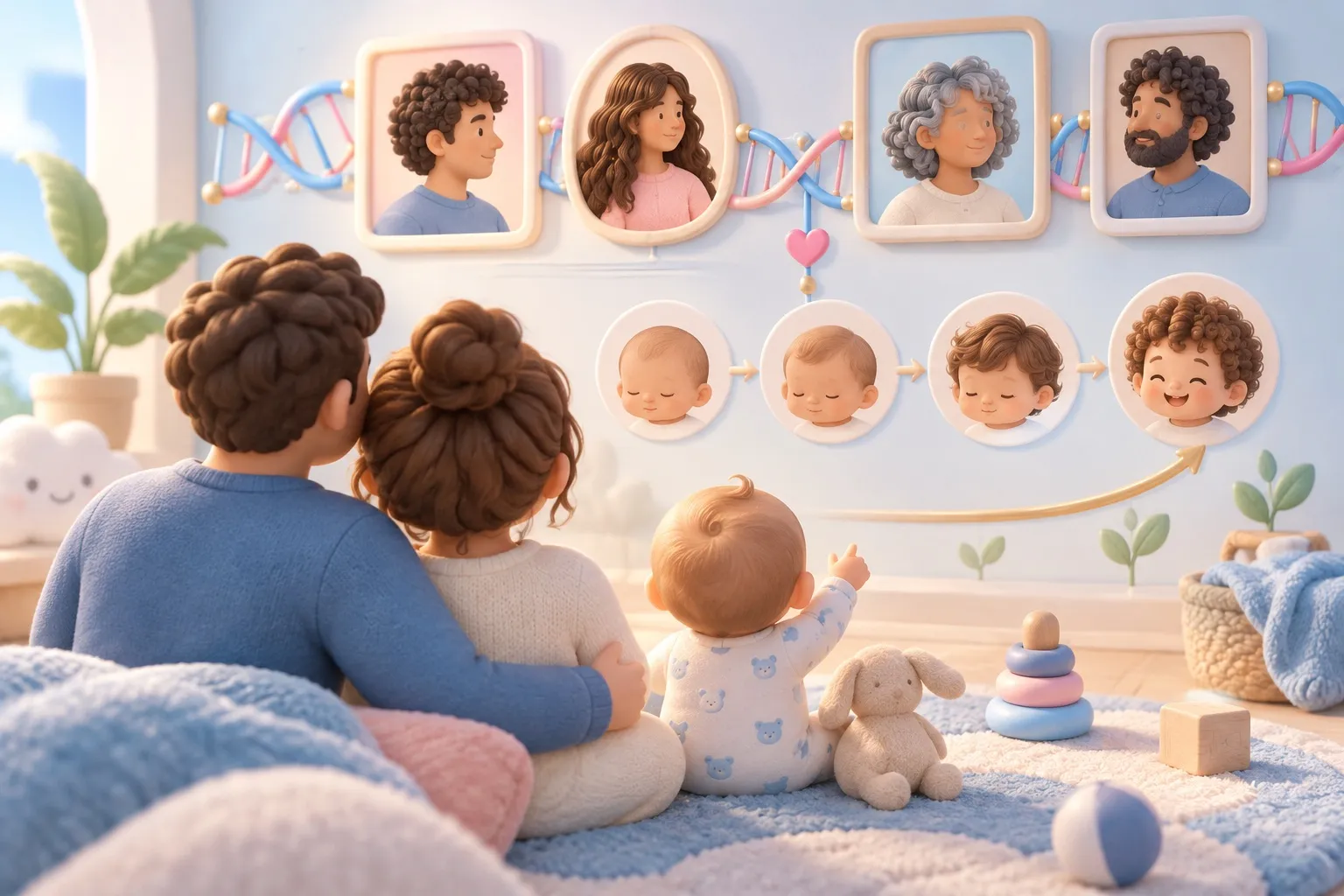
Your baby is more likely to have curly hair if curls run on both sides of the family, but no simple rule decides it. Hair texture is shaped by many genes, and the ones found so far each explain only a small part. Newborn hair is also a poor clue: much of it sheds in the first months, and texture can keep changing as a child grows.
Hair texture is inherited, but not by one gene
Genes play a major role in whether hair is straight, wavy or curly, and many of them are involved. MedlinePlus Genetics, the National Library of Medicine’s genetics reference, says genetic factors appear to play a major role in hair texture and thickness and that many genes contribute.
The genes identified so far differ by ancestry:
- Northern European ancestry: a large study by Medland and colleagues (2009) scanned the genomes of three Australian samples of European descent, several thousand people in all. Variants in the TCHH (trichohyalin) gene, which is active in the hair follicle, were linked to straight hair. They explained only about 6% of the variation in hair shape.
- Latin American ancestry: a genome-wide study of more than 6,000 Latin Americans by Adhikari and colleagues (2016) found a new hair shape locus in the PRSS53 gene, an enzyme made in the hair follicle.
- East Asian ancestry: MedlinePlus notes that variants in EDAR and FGFR2 are linked to hair thickness in Asian populations, and Medland’s paper describes an EDAR variant tied to thick, straight hair.
The 6% figure is the useful part. Even the best-known texture gene leaves most of the story untold, so any “curly hair calculator” is guessing.
For scale, the Medland paper notes that among people of European descent about 45% have straight hair, 40% wavy and 15% curly. Wavy hair is common, which also means a lot of babies land somewhere between their parents.
Is curly hair dominant?
Curly hair isn’t simply dominant or recessive. You’ll often read that curly is dominant, or that curls follow “incomplete dominance” so that one curly and one straight parent give a wavy child. Those rules describe single-gene traits. MedlinePlus Genetics doesn’t describe any single inheritance pattern for hair texture, and the research above shows several genes, each with a small effect.
What the family pattern can tell you is likelihood:
| Parents’ hair | What’s most common | What still happens |
|---|---|---|
| Curly + curly | Curly or wavy | Looser waves, occasionally straighter hair |
| Curly + straight | Wavy, or anywhere in between | Curly, or straight |
| Wavy + wavy | Wavy | Curly or straight |
| Straight + straight | Straight | Waves, sometimes curls, from relatives’ genes |
Like the color tables in our baby hair color guide, this table has no percentages, because the genes behind texture are mostly unknown. Grandparents’ and siblings’ hair adds real information: curls that skipped a parent can still show up in a child.
Why curls often show up after the first year
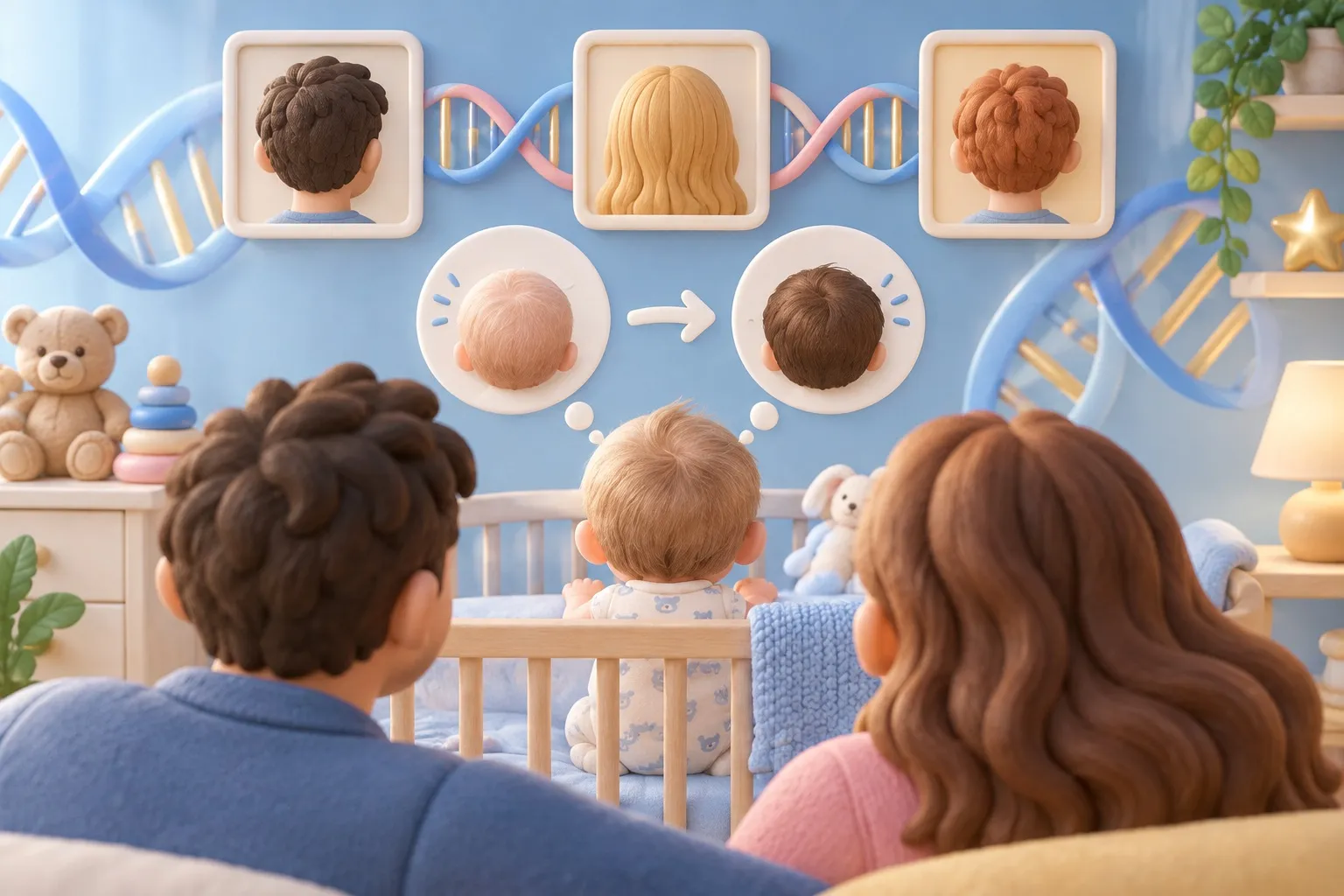
Many babies’ curls appear later because newborn hair is temporary. The American Academy of Pediatrics says almost all babies lose some, possibly all, of their hair in the first few months, and it grows back over a few months. A Cleveland Clinic pediatrician links that shedding to the drop in the mother’s hormones at about 3 months.
Even after the regrowth, texture isn’t fixed. MedlinePlus Genetics says hair texture and thickness can change with age, and that hormones, some medicines and chemical treatments can change it too. Short baby hair also has little length to curl: a curl pattern needs some length before it shows, so a fine, short first coat can look straight on a baby whose hair will curl later.
Some practical points for the first two years:
- Don’t judge by hospital photos. Wet, matted newborn hair tells you very little.
- Watch the longest hair. Any pattern has the most room to show where hair is longest, often at the back or over the ears.
- Look after washing. Hair that kinks or spirals as it dries is giving you an informal clue. These are parent observations, not tested signs.
Imagining your baby’s hair with SeeMyBaby
If you’d like to see a playful version, SeeMyBaby’s parents’ photo portrait takes one photo of each of you and imagines a newborn who blends you both. You can tell the app you’re most curious about hair during setup.
It’s an imagined portrait for fun. The app sees the hair in your photos, not your genes, so if you straighten or relax your curls, use a photo of your natural texture. And since newborns often have little hair anyway, the portrait shows one possible newborn, not the curls your child will have at three.
To see what a scan can show of hair before birth, read hair on a 3D ultrasound. For the bigger picture of eyes, nose, skin and height, our trait-by-trait guide to what your baby will look like puts texture next to the other traits. More guides are on the SeeMyBaby blog.
Sources
- MedlinePlus Genetics (National Library of Medicine): Is hair texture determined by genetics?
- Medland SE, Nyholt DR, Painter JN, et al. Common variants in the trichohyalin gene are associated with straight hair in Europeans. American Journal of Human Genetics, 2009. PMC2775823
- Adhikari K, Fontanil T, Cal S, et al. A genome-wide association scan in admixed Latin Americans identifies loci influencing facial and scalp hair features. Nature Communications, 2016. PMC4773514
- American Academy of Pediatrics, HealthyChildren.org: Hair loss (alopecia)
- Cleveland Clinic: Why is my baby hairy?
Questions parents ask
Do babies have curly hair at birth?
Some do, but newborn hair is a weak clue. Most babies shed some or all of it in the first few months, and the hair that grows back, and the hair at age two or three, can have a different texture.
When does a baby get curly hair?
There’s no set age. Curls need some length to show, so many parents first notice a pattern once the regrown hair is a few inches long, often after the first year.
Can two straight-haired parents have a curly-haired baby?
Yes, though it’s less common than straight or wavy hair. Texture depends on many genes, and curls in the wider family can show up in a child even when neither parent has them.
Does curly hair come from the mother or the father?
From both. A baby gets one copy of each gene from each parent, and texture depends on many genes, so neither side decides it alone.

Also available in: العربية · Deutsch · Español · Français · Italiano · Português (Brasil)