By Sarina Gomez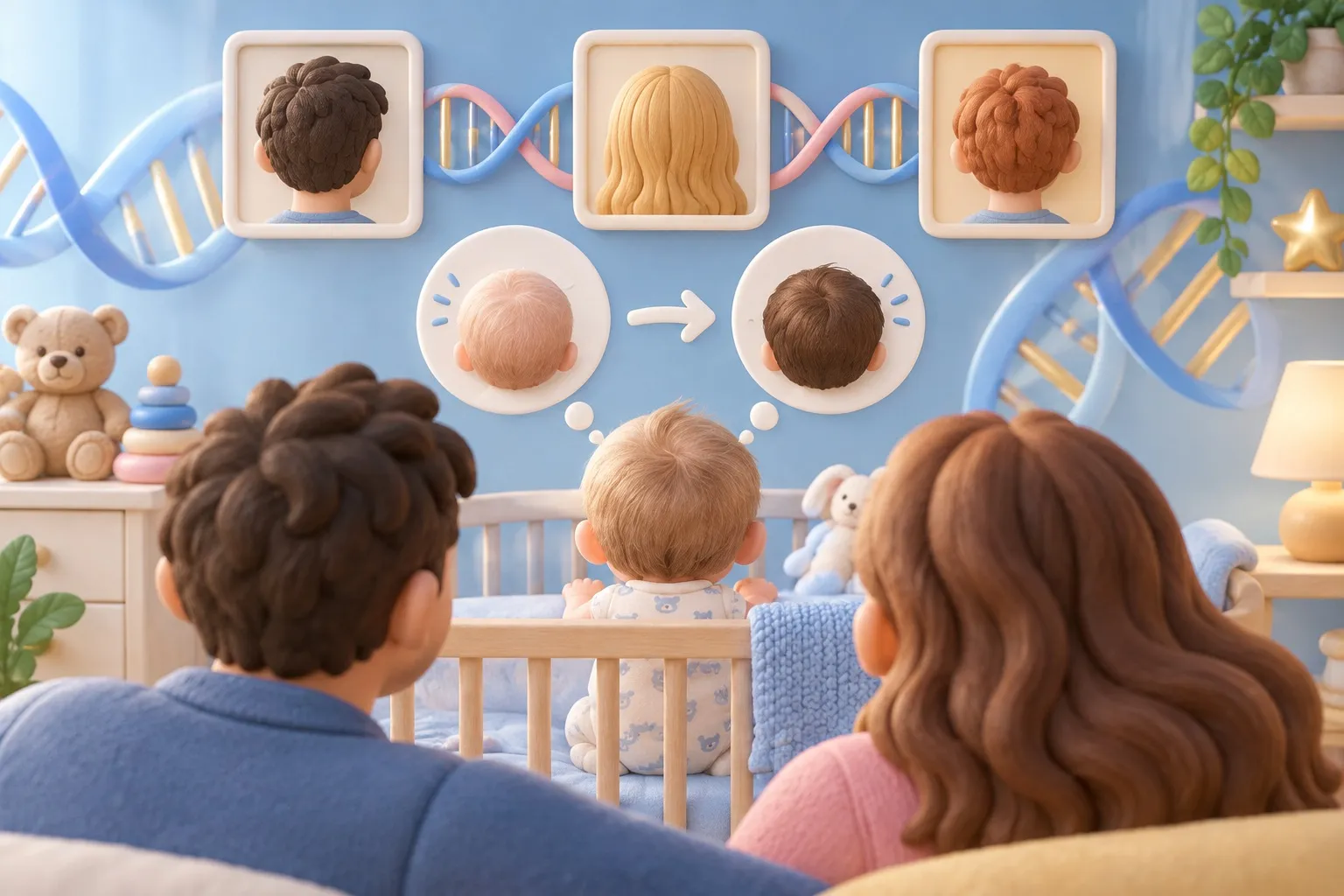
Your baby’s hair color is decided by many genes from both parents, which control how much and which type of melanin the hair makes. That’s why a baby hair color predictor can tell you what’s likely but not what you’ll get. The color can also change twice: newborn hair often falls out in the first months, and light hair tends to darken through childhood.
Two pigments make every hair color
Every natural hair color comes from two kinds of melanin. MedlinePlus Genetics, the National Library of Medicine’s genetics reference, explains that eumelanin gives black and brown shades, pheomelanin gives red, and blond hair has very little eumelanin. The exact mix and amount produce everything from platinum to jet black.
Many genes influence that mix, and MedlinePlus notes that little is known about most of them. The best studied is MC1R:
- When the MC1R receptor is active, hair cells make eumelanin, the brown-black pigment.
- When it’s blocked or inactive, they make pheomelanin, the red-yellow pigment.
- Other genes, including ASIP, OCA2, MITF, TYR and HERC2, raise or lower melanin levels. Some of the same genes also shape eye and skin color, which is why the baby eye color guide reads a lot like this one.
Dark hair is by far the most common outcome: MedlinePlus says more than 90% of people worldwide have black or brown hair.
Will my baby have red hair?
A baby has the best chance of red hair when both parents pass on a changed copy of MC1R. MedlinePlus Genetics describes the pattern:
- One loss-of-function copy of MC1R lowers eumelanin and raises pheomelanin, which can show up as strawberry blond, auburn or red.
- Two loss-of-function copies (one from each parent) almost always produce very red hair.
So two parents without red hair can still have a redhead if each carries one changed copy. Look at the wider family: a red-haired grandparent, auburn highlights in a parent’s beard, or a sibling with red hair are all clues that the variant runs in the family.
Will my baby be blond or brunette?
Blond and brown hair depend on how much eumelanin is made, and many genes have a say. The table below is a qualitative guide, not a calculator. It gives no percentages, because nobody in your family has been tested for the genes that matter, and hair color has far more of them than school genetics suggests.
| Parents’ hair | Most common in children | Also possible | Notes |
|---|---|---|---|
| Dark + dark | Dark brown or black | Lighter brown, blond, red | Light and red variants can hide behind dark hair for generations |
| Dark + blond | Brown | Blond, red | Blond children may darken by their teens |
| Blond + blond | Blond or light brown | Brown, red | Blond in childhood often turns darker later |
| Red + red | Red | Strawberry blond, auburn, brown | Both parents likely carry two changed MC1R copies |
| Red + dark | Brown or auburn | Red | Red needs a changed MC1R copy from the dark-haired parent too |
The grandparent rule: if you want a better guess, add the grandparents’ childhood hair to the picture. Many adults who now have mid-brown hair were blond as children, and that history matters more than their current color.
Why newborn hair falls out and comes back different
The hair your baby is born with is often temporary. The American Academy of Pediatrics says almost all babies lose some, possibly all, of their hair in the first few months, and some lose more on the back of the head. The hair grows back normally over a few months.
A Cleveland Clinic pediatrician links the shedding to hormones: at about 3 months, the hormones a baby got from the mother are gone, and babies may lose some or all of their head hair as those levels drop.
The regrown hair doesn’t have to match the first coat. Then the slower change begins. MedlinePlus Genetics notes that in people of European descent, light hair often darkens with age, and blond children are often darker by their teenage years. Researchers suspect some pigment proteins switch on as children grow, possibly linked to hormones around puberty.
So a dark-haired newborn can become a blond toddler, and a blond toddler can become a brown-haired teenager. The hair at 2 or 3 years old is a better hint of the adult color than the hair in the hospital photos.
How much hair a baby is born with is a separate question from color, and one pregnancy folklore claim has some support. In a small study of 64 women, Costigan and colleagues (2006) found that those with more heartburn tended to have babies with more hair at birth. It’s one small study, but it’s more than most pregnancy tales have behind them.
Imagining your baby’s hair with SeeMyBaby
If you’d like to see one possible version, SeeMyBaby’s parents’ photo portrait takes one photo of each parent and imagines a newborn who blends both of you. In setup, “hair” is one of the things you can say you’re most curious about.
The portrait is entertainment, not a reading of your genes. The app sees your hair in a photo, not the hidden MC1R copy you may carry, and dyed hair will steer it toward the dye. Use photos with your natural color in daylight for a fairer blend.
If you have a 3D scan, our piece on hair on a 3D ultrasound explains what the scan can and can’t show. For texture rather than color, see will my baby have curly hair. More guides are on the SeeMyBaby blog.
Sources
- MedlinePlus Genetics (National Library of Medicine): Is hair color determined by genetics?
- MedlinePlus Genetics: MC1R gene
- American Academy of Pediatrics, HealthyChildren.org: Hair loss (alopecia)
- Cleveland Clinic: Why is my baby hairy?
- Costigan KA, Sipsma HL, DiPietro JA. Pregnancy folklore revisited: the case of heartburn and hair. Birth, 2006. PubMed 17150070
Questions parents ask
Can two brown-haired parents have a blond baby?
Yes. Both parents can carry gene variants for lighter hair that their own brown hair hides, and a baby can inherit those from each of them. Keep in mind that a blond baby may still darken later.
Is red hair recessive?
Mostly. MedlinePlus Genetics says two changed copies of MC1R almost always give very red hair, while one copy can give strawberry blond, auburn or red, so it’s not a simple on/off trait.
When does a baby’s hair color become permanent?
There’s no single age. Newborn hair often sheds in the first months, and light hair can keep darkening through childhood into the teenage years, especially in children of European descent.
Why is my baby’s hair falling out?
Shedding in the first few months is normal for almost all babies, often linked to the drop in hormones after birth. It grows back over a few months; the AAP suggests talking to your pediatrician about hair loss that keeps going.

Also available in: العربية · Deutsch · Español · Français · Italiano · Português (Brasil)