By Sarina Gomez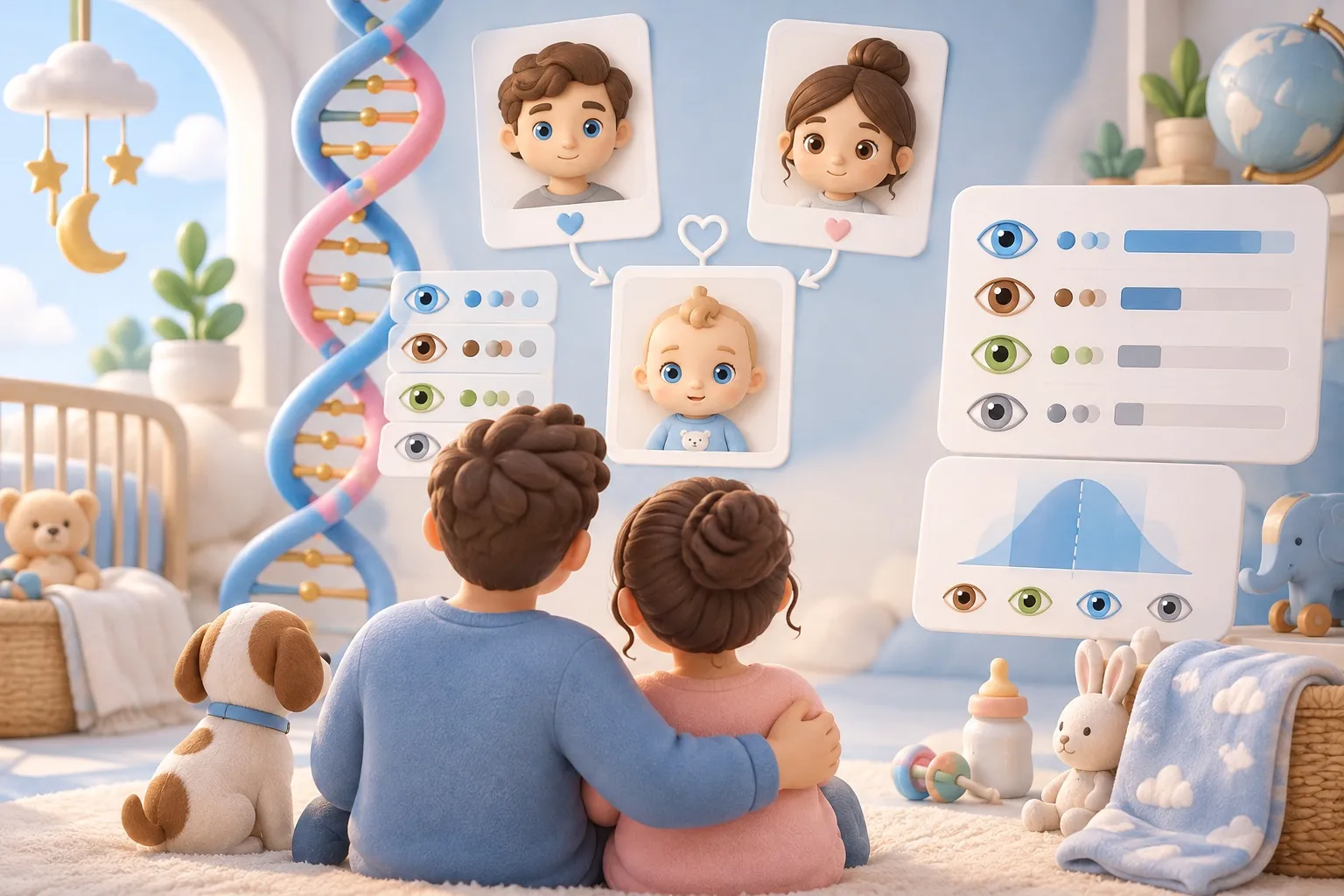
Your baby’s eye color depends on the eye colors in both of your families, but no chart or calculator can tell you for sure. At least 10 genes shape how much pigment ends up in the iris, so parents’ eyes make some colors likely and others merely possible. Two brown-eyed parents can have a blue-eyed baby, and, less often, two blue-eyed parents can have a brown-eyed one.
Eye color comes from many genes, not one
Eye color is a polygenic trait: many genes each nudge the amount of melanin in the iris up or down. MedlinePlus Genetics, the National Library of Medicine’s genetics reference, names two major players, OCA2 and HERC2, which sit next to each other on chromosome 15. OCA2 makes the P protein that helps the cell structures that store melanin mature. A stretch of HERC2 works like a switch for OCA2: one common variant there turns OCA2 down, which means less melanin and lighter eyes.
Eight more genes play smaller roles, including TYR, IRF4 and SLC24A4. Their combined effects produce a continuum of colors rather than neat categories, which is why one child’s “hazel” is another family’s “green” and why siblings’ eyes can differ.
There is no blue pigment in a blue eye. As The Tech Interactive’s Ask a Geneticist explains, blue comes from how light scatters in an iris with little melanin in its front layer. Brown eyes hold a lot of melanin; green and hazel sit in between.
Why the school biology model breaks down
The old rule says brown is dominant, blue is recessive, and two blue-eyed parents can only have blue-eyed children. It works often enough to feel true, and it explains the most common surprise well: two brown-eyed parents who each carry a “light” version can both pass it on, and the baby can end up with blue eyes. Ask a Geneticist walks through exactly that case in a classic answer on brown-eyed parents with blue-eyed kids, with an editor’s note that the simple model is now known to be incomplete.
Where the rule fails is the reverse case. MedlinePlus Genetics states that two blue-eyed parents can have a brown-eyed child. It’s uncommon, but it happens because other genes can add pigment back even when the main HERC2/OCA2 pair points toward light eyes. Ask a Geneticist adds that researchers have long used a single position in HERC2 (rs12913832) to guess brown versus blue, and it doesn’t always match the person’s actual eyes.
What parents’ eye colors make likely
The table below is the honest version of an eye color predictor. It tells you which outcome is most common for each pairing and what can still happen. It gives no percentages, because published calculators rely on the simplified two-gene model, and the real odds depend on genes nobody in your family has been tested for.
| Parents’ eyes | Most common in children | Also possible | How surprising is the exception? |
|---|---|---|---|
| Brown + brown | Brown | Green, hazel, blue | Not very: light-eye variants hide easily in brown-eyed families |
| Brown + blue | Brown or blue | Green, hazel | Not surprising: both colors are common outcomes |
| Brown + green or hazel | Brown | Green, hazel, blue | Not surprising |
| Green + green | Green or hazel | Blue, brown | Somewhat |
| Green + blue | Green or blue | Brown | Somewhat |
| Blue + blue | Blue | Green, brown | Uncommon, but documented (MedlinePlus Genetics) |
How to use it: look one generation further back. If a brown-eyed parent has a blue- or green-eyed parent or sibling, a light-eyed baby becomes more plausible. Grandparents’ eyes carry information that the parents’ own eyes hide.
What it can’t do: tell you the final shade. Even when the color family is right, the exact tone (gray-blue, amber-brown, green with a brown ring) comes from the many smaller genes, and from time.
Newborn eye color is not the final answer
The eye color you see in the delivery room is often not the one your child keeps. A Stanford study of 192 newborns, published by Ludwig and colleagues in Acta Ophthalmologica in 2016, found that about 63% had brown irises at birth and about 21% had blue. So the idea that all babies are born with blue eyes is a myth. The study came from a single children’s hospital, so the exact shares won’t match every population.
What does happen is that melanin in the iris keeps building after birth. Cleveland Clinic says changes usually start between 3 and 9 months, often around 6 months, and the final color can take up to three years to settle. The usual direction is lighter to darker: blue-gray can turn green, hazel or brown, while brown eyes tend to stay brown. Our guide to baby eye color change goes through that timeline month by month.
One medical point belongs here. If a flash photo shows one pupil glowing white instead of red, the American Association for Pediatric Ophthalmology and Strabismus says the child should see an eye doctor right away. That is unrelated to normal eye color change.
Imagining your baby’s eyes with SeeMyBaby
If you’d like to picture a face rather than a table, SeeMyBaby’s parents’ photo portrait takes one photo of each of you and imagines a newborn who blends both. During setup the app asks what you’re most curious about, and “eyes” is one of the options, so the portrait leans into that feature.
Keep the result in the same box as the table above: an imagined portrait for fun. The app can’t read genes from a photo, and it can’t know whether a hidden blue variant runs in your family. A photo with good light and your eyes clearly visible gives it the best material to work with.
For the other traits, our trait-by-trait guide to what your baby will look like covers hair, skin, nose and height, and the baby hair color guide explains why hair follows similar rules to eyes. More guides are on the SeeMyBaby blog.
Sources
- MedlinePlus Genetics (National Library of Medicine): Is eye color determined by genetics?
- MedlinePlus Genetics: OCA2 gene
- The Tech Interactive, Ask a Geneticist: Can two blue-eyed parents have a brown-eyed child? and How can two brown-eyed parents have blue-eyed children?
- Ludwig CA, Callaway NF, Fredrick DR, Blumenkranz MS, Moshfeghi DM. What colour are newborns’ eyes? Prevalence of iris colour in the Newborn Eye Screening Test (NEST) study. Acta Ophthalmologica, 2016. PubMed 27061128
- Cleveland Clinic: When do babies’ eyes change color?
- American Association for Pediatric Ophthalmology and Strabismus: Leukocoria
Questions parents ask
Can two brown-eyed parents have a blue-eyed baby?
Yes. If both parents carry light-eye variants behind their brown eyes, the baby can inherit those from each of them and end up with blue eyes. It’s one of the most common eye color surprises.
Is there an accurate baby eye color calculator?
No calculator can be accurate for an individual baby, because at least 10 genes are involved and most calculators use a two-gene model. Treat any result as “likely” or “possible,” never as a forecast.
Which parent decides the baby’s eye color?
Neither one alone. The baby gets one copy of each eye color gene from each parent, and the combination across many genes sets the final shade.
When will I know my baby’s real eye color?
Most changes happen in the first year, with many around 6 months, but Cleveland Clinic notes the color can take up to three years to settle. Brown at birth usually stays brown.

Also available in: العربية · Deutsch · Español · Français · Italiano · 日本語 · 한국어 · Português (Brasil)