By Sarina Gomez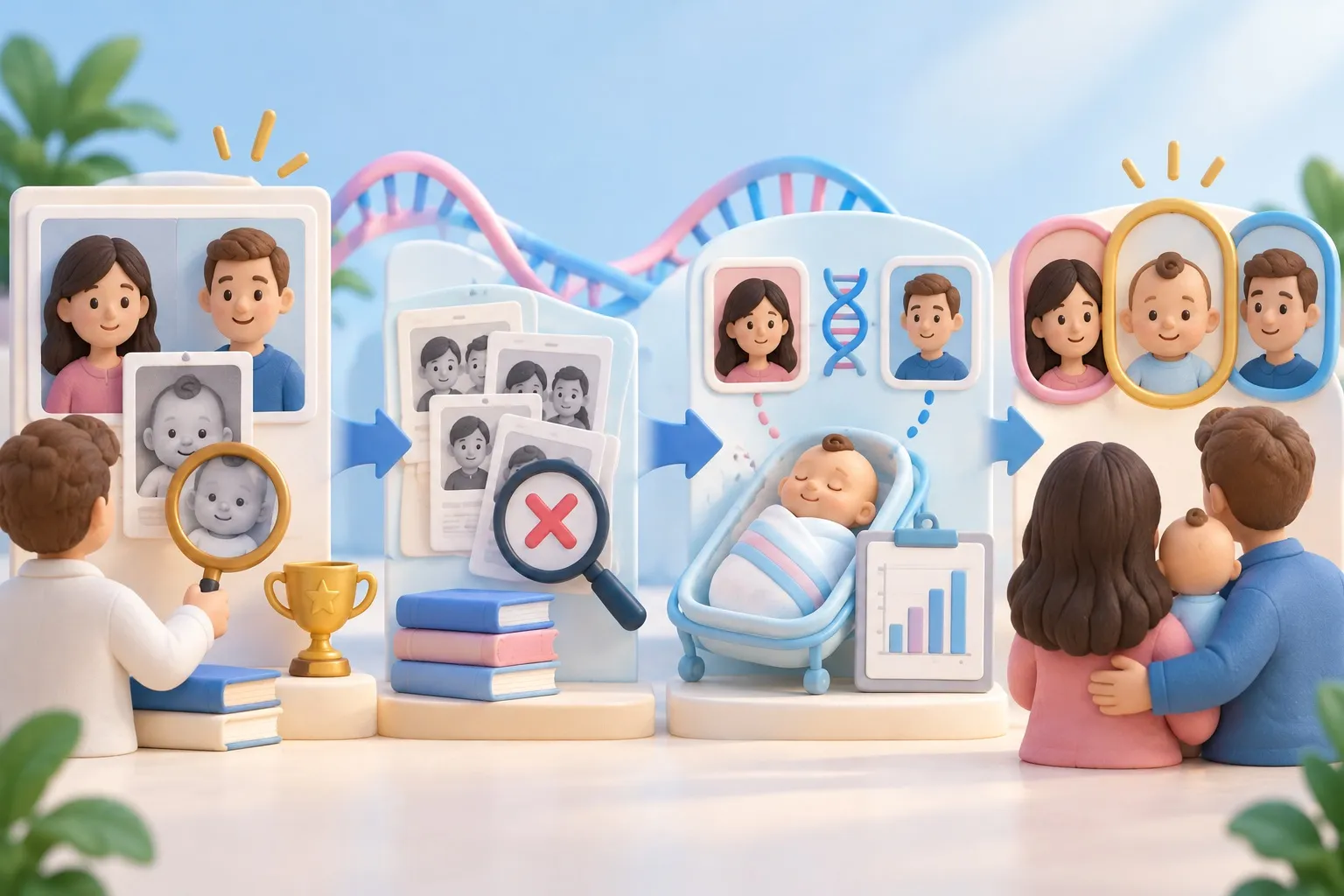
On average, babies don’t look more like either parent. The famous 1995 finding that one-year-olds resemble their fathers has not been replicated, and the larger studies since then found most children resemble both parents about equally. Where a lean does show up, it often points the other way: in two studies, strangers matched newborns to their mothers more easily than to their fathers.
That is the short answer. The longer one is more interesting, because the research is a small chain of studies, each one correcting the last. Here they are in order.
The 1995 study that started the “babies look like Dad” idea
The idea comes from a one-page letter in Nature. Psychologists Nicholas Christenfeld and Emily Hill of UC San Diego published “Whose baby are you?” in December 1995. They showed volunteers photos of children at ages 1, 10 and 20, each next to three adults, one of whom was the real parent, and asked how alike each pair looked.
The striking result was narrow. Children were generally not judged more similar to their own parents than to strangers, with one exception: one-year-olds were matched to their fathers better than chance. The authors offered an evolutionary explanation. A mother knows a baby is hers; a father can’t be as sure, so a baby who looks like him might get more of his care.
It was a tidy story, and it spread fast. It is still the study most articles quote, often without the follow-ups.
The replications that failed
The follow-up studies did not find a father advantage. Here is what they reported:
- Brédart and French, 1999. In a paper titled “Do Babies Resemble Their Fathers More Than Their Mothers? A Failure to Replicate Christenfeld and Hill (1995)” in Evolution and Human Behavior, judges looked at children aged 1, 3 and 5. They matched children to mothers and fathers about equally well. Any resemblance they picked up was better than chance but far from obvious.
- Bressan and Grassi, 2004. This larger study, “Parental resemblance in 1-year-olds and the Gaussian curve”, had 80 judges rate 40 one-year-olds against sets of three adults. Judges again beat chance, and the ratings fell on a normal bell curve: a few babies leaned clearly toward one parent, but most resembled both to about the same degree. Paola Bressan later told Scientific American that no study had “either replicated or supported” the 1995 result.
One methodological detail matters here. In 1995, judges rated resemblance on a scale; in the later studies, they had to guess the actual parent directly. Small design choices like this, plus photo quality and lighting, can swing results in studies with only a few dozen children.
What the newborn studies found: a lean toward Mom
The studies of newborns found the opposite of the 1995 claim. Two research teams looked at babies in their first days of life:
- McLain and colleagues, 2000. In “Ascription of resemblance of newborns by parents and nonrelatives”, unrelated judges matched babies aged one to three days more readily to their mothers. Meanwhile, mothers tended to say the baby looked like the father. As the researchers put it, the way mothers remark on resemblance “does not reflect actual resemblance.”
- Alvergne, Faurie and Raymond, 2007. This French team followed resemblance from birth to age 6 using photos rated by unrelated judges. At all ages, children resembled both parents more than chance. Newborn boys and girls resembled their mothers more. For girls, that lean toward Mom persisted. For boys, it flipped: between about 2 and 3 years of age, boys resembled their fathers more. The study also confirmed the 2000 pattern of mothers telling everyone the newborn looked like Dad.
Put together, the research reads like this:
| Age | What the studies found | Study |
|---|---|---|
| First days | Strangers match newborns to Mom more easily; Mom often says “looks like Dad” | McLain et al. 2000; Alvergne et al. 2007 |
| 1 year | One study found a Dad lean; later, larger studies found both parents about equally | Christenfeld & Hill 1995; Bressan & Grassi 2004 |
| 1, 3 and 5 years | No father advantage | Brédart & French 1999 |
| 2–3 years | Boys shift toward Dad; girls stay closer to Mom | Alvergne et al. 2007 |
Why everyone says your baby looks like Dad anyway
Relatives say it because it’s a social habit, not because it’s measured. The newborn studies above caught mothers doing it consistently, and the researchers linked the habit to the same reassurance idea from 1995: saying “he’s got your chin” invites the father in.
There are plainer reasons too. Newborn faces are puffy from birth and change fast, so people latch on to one feature, like a nose shape or a hairline, and match it to whoever they’re standing next to. A baby’s face in the first weeks also has the rounded cheeks, small nose and short chin that all babies share, which makes resemblance hard to judge for anyone. Our guide to how babies’ features change up to age 4 walks through what shifts and when.
What genetics says about who your baby will look like
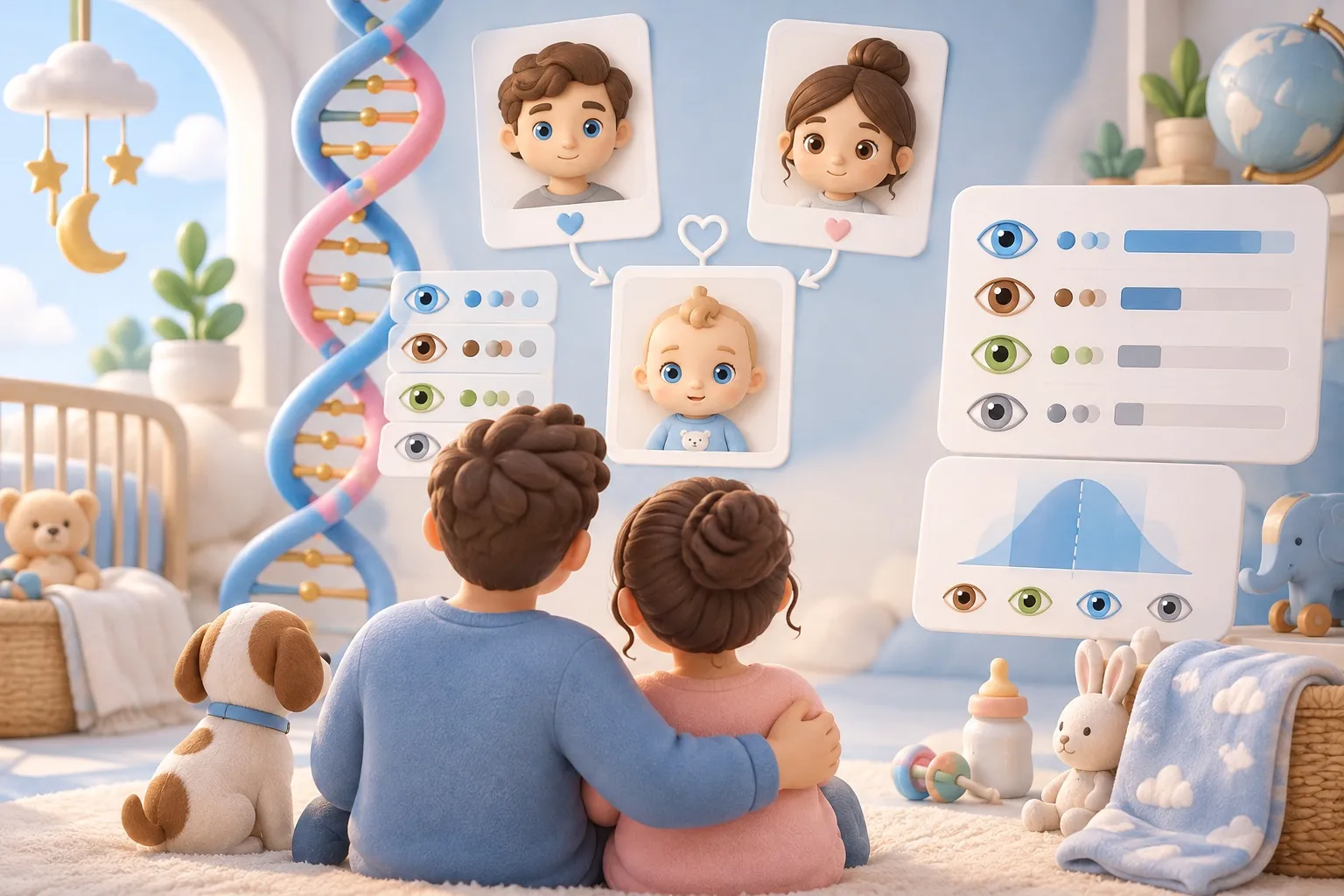
Your baby gets half of their DNA from each parent, but that doesn’t mean half of each face. Most traits you can see, including eye color, are shaped by many genes acting together. One child can end up with Dad’s eyes and Mom’s jawline; a sibling can land the other way around. Traits that seem to skip a generation, like a grandparent’s curls or dimples that run in one side of the family, come from the same reshuffle.
That’s why the honest answer to “will my baby look like me?” is that some features probably will, and nobody can tell you which ones in advance. If you want the trait-by-trait version, with what’s known for eyes, hair, skin and height, read What Will My Baby Look Like?.
Seeing a blend of both of you with SeeMyBaby
If you’d like to picture a baby who blends both of you, the parents’ photo portrait in SeeMyBaby takes one photo of each parent and imagines a newborn who mixes your features. You can tell the app you’re most curious about family resemblance, and it shapes the portrait around that.
It’s an imagined portrait for fun, not a forecast. The research above shows why: even trained eyes can’t reliably say which parent a real one-year-old favors, so no app can say it about a baby who hasn’t been born yet. Treat the result as one possible face, a nice thing to look at together while you wait to meet the real one.
Sources
- Christenfeld, N. J. & Hill, E. A. (1995). Whose baby are you? Nature, 378, 669.
- Brédart, S. & French, R. M. (1999). Do babies resemble their fathers more than their mothers? A failure to replicate Christenfeld and Hill (1995). Evolution and Human Behavior, 20, 129–135.
- McLain, D. K., Setters, D., Moulton, M. P. & Pratt, A. E. (2000). Ascription of resemblance of newborns by parents and nonrelatives. Evolution and Human Behavior, 21.
- Bressan, P. & Grassi, M. (2004). Parental resemblance in 1-year-olds and the Gaussian curve. Evolution and Human Behavior, 25, 133–141.
- Alvergne, A., Faurie, C. & Raymond, M. (2007). Differential facial resemblance of young children to their parents: who do children look like more? Evolution and Human Behavior, 28, 135–144.
More looks guides are on the SeeMyBaby blog.
Questions parents ask
Do newborns look more like their mother or father?
In the two studies that looked at babies in their first days, unrelated judges matched newborns to their mothers more easily than to their fathers. Mothers, meanwhile, often said the baby looked like the father.
Is it true that firstborns look like their dad?
There’s no good evidence for it. The father-resemblance idea traces back to one 1995 study of one-year-olds, and later studies did not replicate it.
Do baby boys look more like their dad?
One French study found boys shifted from resembling their mothers at birth to resembling their fathers at around 2 to 3 years old. Girls kept a slight lean toward their mothers.
When can you tell who a baby looks like?
Not reliably in the first weeks, when faces are puffy and changing. Resemblance becomes easier to judge in the toddler years, once the nose, chin and face shape have grown into proportion.

Also available in: Deutsch · العربية · Español · Français · Italiano · 日本語 · 한국어 · Português (Brasil)